Skip to content

VRM Reservoir surveillance platform

Field data to reservoir decisions, in minutes.

VRM cleans and reconciles production data, diagnoses well and reservoir behaviour, forecasts performance and ranks interventions, with the engineering evidence behind every result.

Offline-first · runs behind your firewallTested on real offshore field dataCompatible with Petrel, OFM & historians

01 The problem

The bottleneck isn’t the simulator. It’s the data.

Before a single forecast or workover decision, engineers spend weeks reconciling production histories and separating reservoir response from operating changes. VRM automates that path from raw data to decision.

A

Fragmented data

Allocations, well tests, pressures and events live in different systems, with gaps, unit errors and silent shut-ins.

B

Manual diagnostics

Decline, water, gas and pressure analyses are run well by well, across disconnected tools.

C

Single-line answers

Decisions need uncertainty, constraints and economics, not one deterministic forecast.

02 The platform

Two working modules. One reservoir picture.

Module 01 · AFPA

Automated Field Performance Analysis

Full-field performance analysis, decline forecasting and intervention screening, running entirely on the engineer’s workstation.

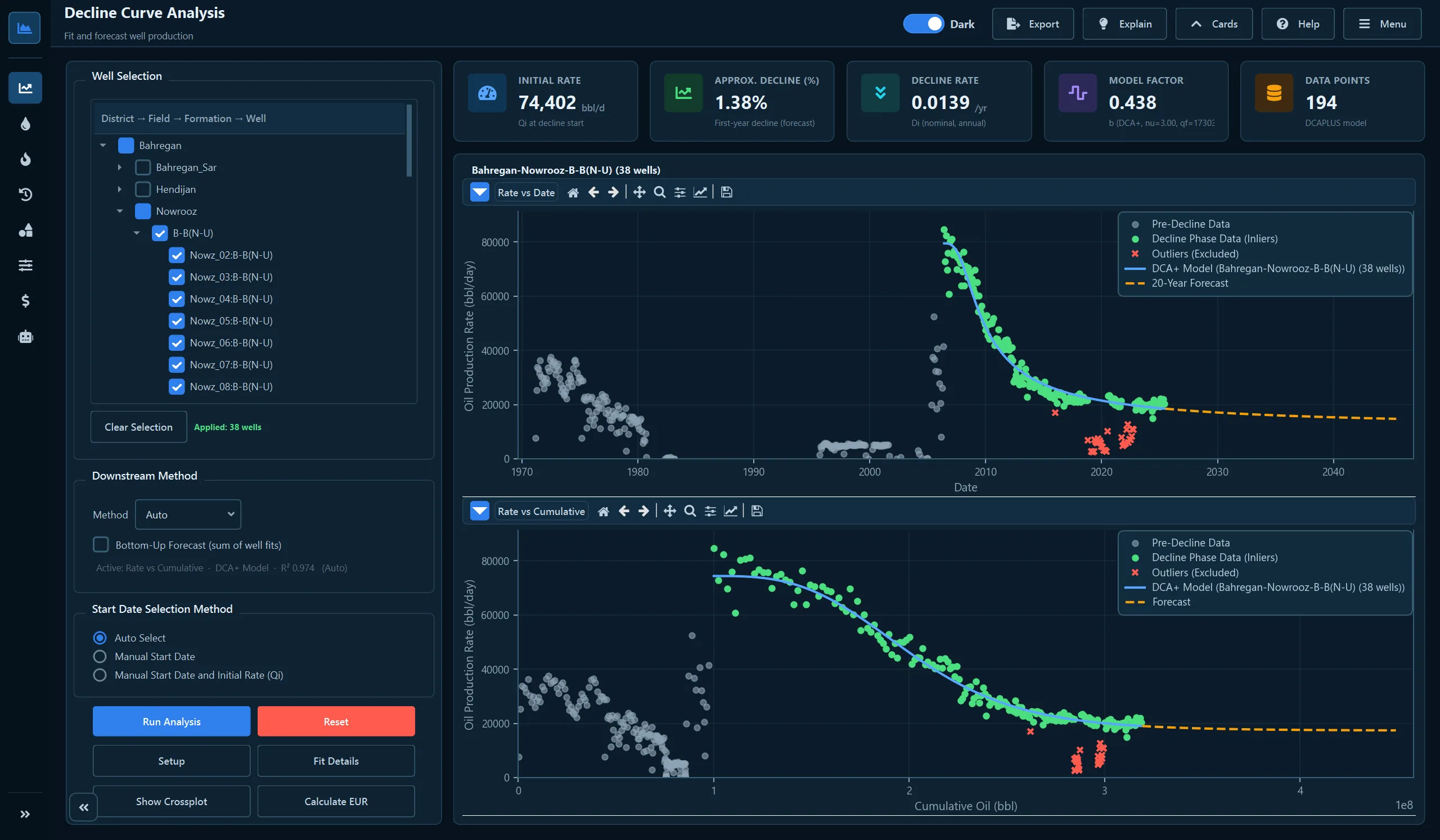
  • DCA+ decline engine with P10 / P50 / P90 ranges
  • Automated production-data QC and reconciliation
  • Pressure, injection, water and gas diagnostics
  • Well Register ranking opportunity against confidence
  • Economics, one-click reports and an offline AI copilot
Explore AFPA →
AFPA · Decline analysis
AFPA decline curve analysis showing fitted production history and forecast
Module 02 · VFM Studio

Virtual Flow Metering

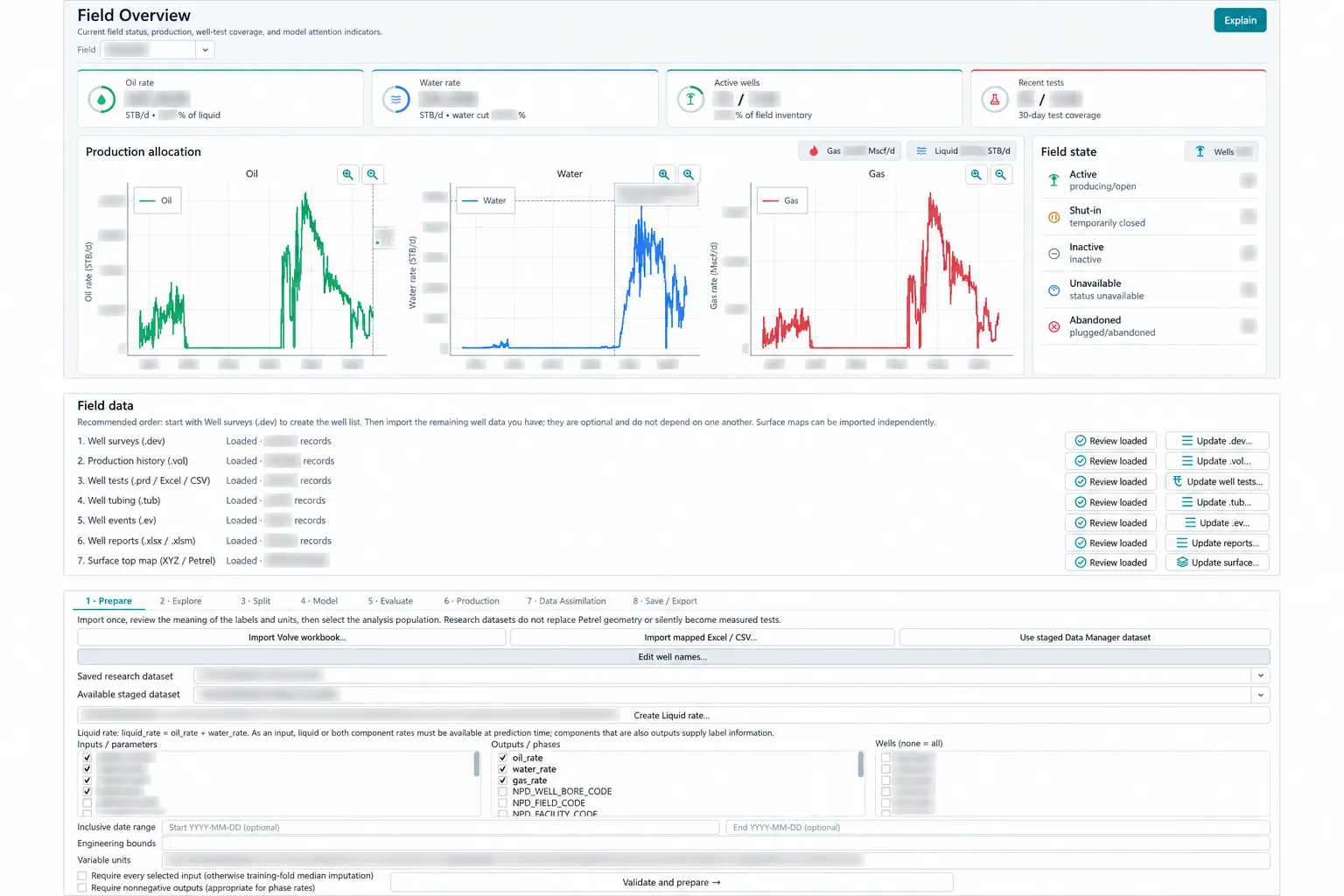
Per-well oil, water and gas rate estimates from existing sensors, validated against well tests and corrected as new measurements arrive.

  • Petrel, OFM, Excel and CSV import with review checks
  • Thirteen model families with explicit validation designs
  • Error analysis by well, phase, rate range and regime
  • Kalman-filter data assimilation without retraining
Explore VFM Studio →
VFM Studio · Field overview
VFM Studio field overview with phase histories, well status and test coverage

03 How it works

A traceable chain from observation to action.

Each step keeps its inputs, assumptions and confidence, so engineers can review why a result was produced, not only what it is.

  1. 01

    Ingest

    Production, pressure, injection, well-test, PVT and completion data from historians, OFM, Petrel and spreadsheets.

  2. 02

    Quality-check

    Every record is scored for completeness, allocation confidence and operational contamination. Nothing is deleted.

  3. 03

    Diagnose

    Decline, pressure, injection, water and gas diagnostics separate reservoir behaviour from operating changes.

  4. 04

    Forecast

    Physics-constrained and machine-learning forecasts, each with an interval, a baseline and a validity status.

  5. 05

    Decide

    Wells ranked by opportunity and data confidence, with economics and an audit trail for every recommendation.

04 Field-tested

Proven on a giant offshore field.

VRM was run on real data from a mature offshore oil field. Every figure below can be reproduced from the field’s production export.

~3bn bblOil initially in place in the pilot reservoir
38Wells, with more than 30 years of production history
~2minFor a complete AFPA run: data QC, forecast and candidate screen
226Production changes flagged that no choke change explained
16Wells ranked for intervention review
61.5%Lower VFM error after data assimilation (public Volve data)

05 Who it’s for

Built for teams that need answers before the next review.

Oil and gas operators

Mid-sized private and national production companies that need faster field reviews without a large simulation team.

Field-development consultancies

Shorter study cycles: hand clients a QC’d, diagnosed and ranked field in days instead of weeks.

Digital-energy companies

A reservoir-intelligence layer that sits alongside existing simulators, historians and dashboards.

Next step Proof of value

See VRM on your own field data.

Start with a paid proof of value on one field: we load your production history, run the full analysis and walk your engineers through the results.